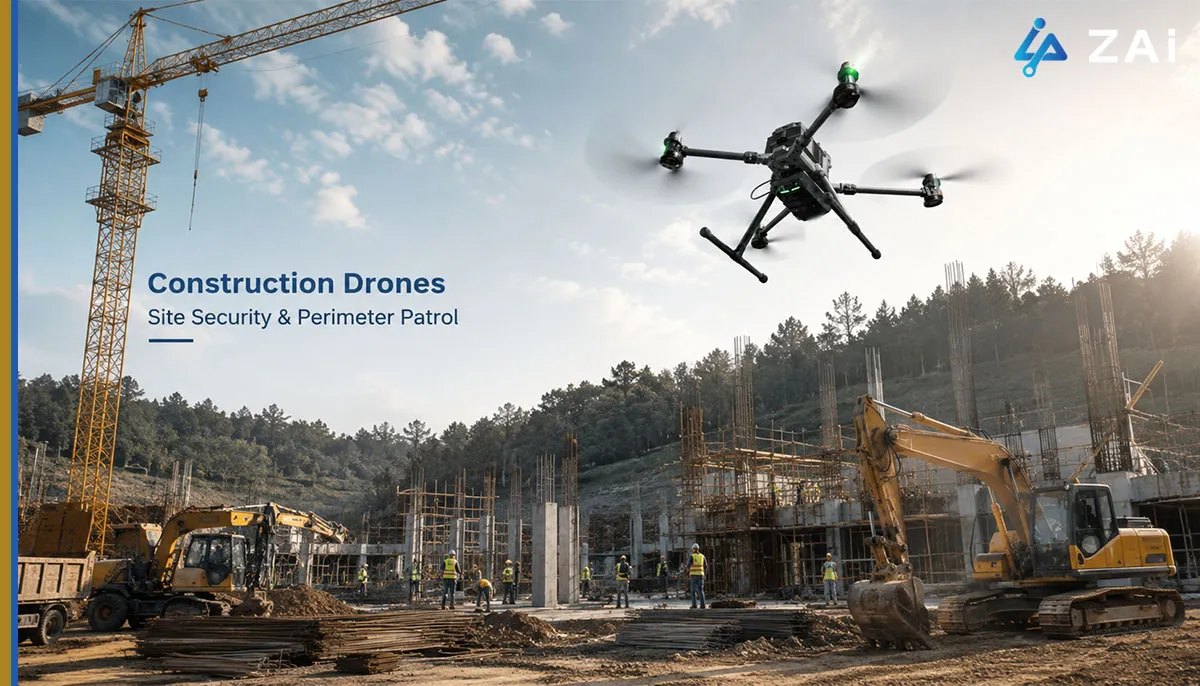
Construction Drones for Site Security & Perimeter Patrol
Construction sites are changing every day. New structures rise, temporary access points move, materials are relocated, and the perimeter can look completely different from one day to the next. At the same time, large quantities of equipment, cables, tools, fuel, and construction materials may remain on-site after working hours, creating security challenges that fixed cameras and conventional foot patrols cannot always address effectively.
This is where construction drones are becoming an increasingly practical tool for modern site security and perimeter patrol.
By combining autonomous flight, high-resolution imaging, thermal sensing, AI-based detection, and remote communications, drones can provide a flexible aerial layer of security around construction sites. Instead of relying entirely on personnel walking fixed routes or monitoring dozens of stationary cameras, security teams can use drones to patrol large and changing areas from an elevated perspective, investigate alarms quickly, and provide real-time visual information to decision-makers.
For construction companies, developers, security contractors, and infrastructure operators, the objective is not simply to put a drone into the sky. The real value lies in creating an integrated Site Security & Perimeter Patrol solution that connects the aircraft, payload, software, alarm systems, and security operations into one workflow.
Why Construction Sites Need a New Approach to Security
Traditional construction-site security typically combines perimeter fencing, access-control systems, fixed surveillance cameras, lighting, and human guards. These systems remain important, but each has limitations.
A fixed camera can continuously monitor one direction, but its field of view is limited. A security guard can patrol a perimeter, but walking several kilometers every night is time-consuming and difficult to maintain at consistent intervals. Temporary structures, stacked materials, scaffolding, unfinished buildings, and construction vehicles can also create new blind spots.
A drone changes this equation by providing mobile aerial surveillance.
A single aircraft can follow predefined routes along fences, gates, storage areas, temporary access roads, and other high-risk zones. When an alarm is triggered, the drone can also be dispatched to the location to provide a closer look before security personnel enter the area.
This makes aerial patrol particularly useful for large construction projects, infrastructure projects, industrial developments, energy facilities, and remote construction sites.
Automated Perimeter Patrol After Working Hours
One of the most straightforward applications of construction drones is automated perimeter inspection during evenings, nights, weekends, and other non-working periods.
A drone can be programmed to follow a repeatable route around the construction site's perimeter. Instead of relying on a guard to physically inspect every section of the fence, the drone can repeatedly check designated areas and transmit live video to a security control center.
Typical patrol points may include:
Construction-site entrances and vehicle gates
Temporary openings in perimeter fencing
Material storage areas
Equipment and machinery parking zones
Fuel and power-storage areas
Temporary roads and access routes
Areas adjacent to public roads
Remote corners and locations hidden from fixed cameras
AI-assisted video analysis can further help identify people, vehicles, or other abnormal activity within predefined zones.
For example, if a person enters a restricted area outside working hours, the system can generate an alert and automatically send the relevant video feed to security personnel. Rather than reviewing hours of surveillance footage after an incident, operators can focus on the event as it happens.
Thermal Imaging for Nighttime Site Security
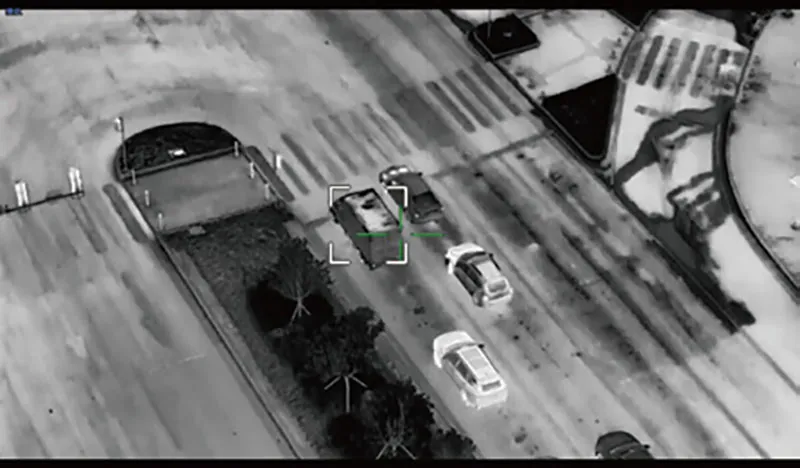
Nighttime surveillance is one of the areas where an aerial platform can provide significant additional value.
A conventional RGB camera depends heavily on available light. Construction sites, however, may contain areas with limited lighting or complete darkness. Thermal imaging provides a different type of information by detecting heat signatures rather than relying exclusively on visible light.
A Dual-sensor gimbal combining a visible-light camera with a thermal camera can therefore provide two complementary perspectives.
The visible camera can deliver detailed images during daylight and help operators inspect objects, vehicles, signs, gates, and other site features. The thermal sensor can assist in detecting people or vehicles in low-light environments and can help identify heat-related anomalies.
A professional drone gimbal camera can also incorporate optical zoom, allowing operators to inspect a suspicious target from a safer distance without immediately flying the aircraft close to the subject.
For more demanding applications, a multi-sensor payload may combine:
The right configuration depends on the size of the site, required detection distance, lighting conditions, flight regulations, and security objectives.
Alarm-Triggered Drone Response: From Detection to Verification
A major advantage of integrating drones with existing security infrastructure is the ability to turn the aircraft into a first responder for security events.
Imagine that an infrared beam, perimeter sensor, access-control system, or other ground-based detection device identifies unusual activity near a remote section of the site.
Instead of immediately sending a security team into an uncertain situation, the system can trigger a drone mission.
Depending on the system architecture and applicable regulations, the workflow can be designed around:
Ground sensor → Security alert → Drone dispatch → Aerial verification → Live video → Operator decision → Security response
The drone can fly toward the designated location and provide live imagery to the security center. Operators can determine whether the alarm was caused by a person, vehicle, animal, environmental movement, or another source.
This can help reduce unnecessary responses to false alarms while giving security personnel better situational awareness when a genuine incident occurs.
Active Deterrence with Lights and Voice Communication
Surveillance does not always need to end with detection.
For suitable security applications, drones can also be equipped with drone accessories such as high-intensity spotlights and loudspeakers. When a suspicious person is detected inside a restricted area, the aircraft can illuminate the area and deliver a predefined or live voice warning.
For example:
“This is a restricted construction area. You are not authorized to enter. Please leave the area immediately.”
The combination of aerial visibility, lighting, and voice communication can provide an immediate deterrent while allowing security personnel to remain at a safer observation point.
Such functions should always be deployed according to local laws, aviation requirements, privacy regulations, and site security policies.
A Drone with Multiple Missions for Daytime Construction Safety
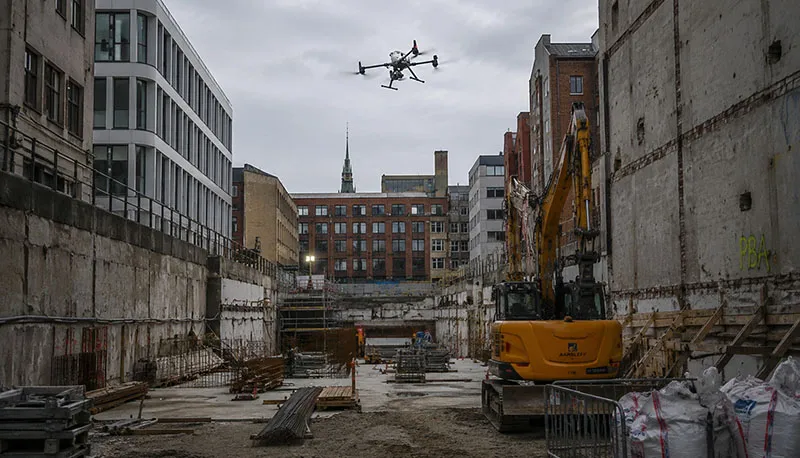
The value of a construction drone does not have to disappear when the security shift ends.
During the day, the same aircraft can support construction safety and operational inspections.
For example, aerial inspections can help teams identify:
Missing safety helmets or high-visibility clothing
Unsafe access areas
Potential fall hazards
Unprotected excavation zones
Blocked emergency routes
Improperly stored materials
Temporary electrical or fire-safety concerns
Unauthorized personnel entering restricted work zones
This creates an important operational advantage: instead of purchasing a drone system exclusively for nighttime security, construction companies can design a multi-purpose drone program that supports security, safety, surveying, mapping, progress tracking, and inspection.
The result can be a more efficient utilization of both the aircraft and its payload.
The Importance of the Right Drone Gimbal Camera
For Site Security & Perimeter Patrol, choosing the aircraft alone is not enough. The payload often determines what the drone can actually see and how useful the resulting information will be.
A professional drone payloads with camera should be selected according to the site's operational requirements.
For a small urban construction site, a compact dual-sensor payload may be sufficient. For a large infrastructure project, a longer-range zoom camera, thermal sensor, laser rangefinder, and stabilized three-axis gimbal may be more appropriate.
Key considerations include:
Visible-Light Resolution
High-resolution imaging helps operators inspect gates, vehicles, equipment, construction materials, and other targets during daylight.
Optical Zoom
Zoom capability allows operators to investigate distant objects without unnecessarily bringing the aircraft close to them.
Thermal Sensitivity
Thermal imaging becomes particularly valuable for nighttime patrols and low-visibility environments.
Gimbal Stabilization
A stabilized gimbal helps maintain usable imagery while the aircraft is moving or hovering, which is essential for remote inspection.
Laser Rangefinding
For advanced security applications, laser rangefinding can help estimate the distance to a target and support more accurate situational awareness.
Autonomous Drone Infrastructure for 24/7 Operations
For large construction sites, manually launching a drone for every patrol can quickly become inefficient.
This is where an autonomous drone station, often described as a Drone-in-a-Box system, can become an important component of the overall solution.
An automated station can be designed to support functions such as:
Automatic takeoff and landing
Battery charging or battery management
Scheduled patrol missions
Remote mission control
Weather monitoring
Remote video transmission
Automated return-to-station operations
With appropriate system integration, a security team can schedule regular perimeter patrols rather than manually preparing the aircraft for every mission.
The result is a shift from “drone as a manually operated camera” toward “drone as an automated security asset.”
For some specialized fixed-area surveillance applications, tethered drone systems can also be considered. A tether provides continuous power from the ground and allows the aircraft to remain airborne for extended periods, making it potentially suitable for monitoring critical entrances, gates, or other designated areas.
RTK Positioning and Repeatable Patrol Routes
Construction environments are constantly changing. Buildings grow taller, cranes move, temporary structures appear, and access roads change.
For this reason, repeatable navigation is an important consideration.
RTK positioning can provide high-precision positioning for applications where consistent flight paths and accurate geographic reference are important. When combined with obstacle avoidance and appropriate flight planning, the system can repeatedly patrol defined sections of a perimeter with greater positional consistency.
A construction drone system can also use updated site maps or 3D models to adapt mission planning as the project develops.
This is particularly useful for large construction projects where the physical environment changes significantly over months or years.
AI-Based Detection and Video Analytics
The effectiveness of aerial security does not depend only on how much video a drone can collect. It also depends on how quickly useful information can be extracted from that video.
AI-based analytics can help reduce the burden on security operators by automatically identifying predefined objects or events.
Depending on the software and model capabilities, applications may include:
Person detection
Vehicle detection
Restricted-zone intrusion
Virtual perimeter alerts
Smoke or fire detection
Safety-equipment recognition
Abnormal activity detection
Instead of continuously watching a live screen, operators can receive alerts when a defined event occurs.
This is particularly important for large sites where multiple cameras, drones, sensors, and access-control systems may generate large quantities of data.
Integrating Drones with Existing Construction Security Systems
A drone should not operate as an isolated device.
A more effective architecture connects the drone platform with the construction site's existing security infrastructure.
A typical system may include:
Perimeter Sensors + Access Control + Fixed CCTV + Construction Drones + AI Analytics + Security Control Center
When these components share information, each system can compensate for the limitations of the others.
Fixed cameras provide continuous observation of specific locations. Ground sensors provide event triggers. Drones provide mobile aerial verification. AI analyzes video and generates alerts. Human operators make the final operational decision.
This layered approach can make the overall security system more flexible without requiring the drone to replace every existing security technology.
Choosing an Industrial Drone Manufacturer for Construction Security
The requirements of a construction-site security system are very different from those of a consumer drone.
An experienced industrial drone manufacturer should be able to evaluate not only the aircraft but the entire operational environment.
Important factors include:
Aircraft endurance
Weather resistance
Payload capacity
Dual-sensor or multi-sensor compatibility
Thermal imaging capability
Optical zoom
Obstacle avoidance
RTK positioning
Communication range
4G/5G connectivity
Autonomous flight capability
Drone station compatibility
Software integration
Payload and drone accessories
Local regulatory requirements
The best platform is therefore not necessarily the aircraft with the highest specification on paper. It is the platform that can reliably perform the required missions within the site's actual environmental, technical, and regulatory constraints.
A Customized Site Security & Perimeter Patrol Solution
Every construction project has a different security profile.
A high-rise building site in a dense urban area may require compact aircraft, precise navigation, and strong obstacle avoidance. A large infrastructure project may require long-endurance platforms, thermal imaging, extended communications, and autonomous patrol stations. A remote construction site may place greater emphasis on communication coverage, weather resistance, and automated operations.
For this reason, an off-the-shelf drone is not always the most effective solution.
HongKong Global Intelligence Technology Group Limited can work with customers to develop customized Site Security & Perimeter Patrol solutions, combining the appropriate drone platform, Dual-sensor gimbal, drone gimbal camera, autonomous flight system, communication technology, AI analytics, and drone accessories according to the project's requirements.
Depending on the application, the solution can be designed around manual inspection, scheduled autonomous patrol, alarm-triggered response, or a hybrid operational model.
The goal is simple: turn aerial technology into a practical layer of construction-site security that can operate alongside existing security infrastructure.
Frequently Asked Questions
Can construction drones patrol a site automatically?
Yes. With appropriate autonomous flight technology, predefined routes can be scheduled for recurring perimeter patrols. More advanced systems can integrate autonomous drone stations for remote launch, landing, and charging operations.
Is a Dual-sensor gimbal better for nighttime construction security?
A dual-sensor configuration combining visible-light and thermal imaging can be highly useful for nighttime security because the two sensors provide complementary information. The ideal payload, however, depends on the site's size, lighting, detection distance, and security requirements.
Can a drone respond automatically when a perimeter alarm is triggered?
A properly integrated system can be designed to use ground-based alarms as triggers for drone missions. The exact level of automation depends on the drone platform, software, communications infrastructure, aviation regulations, and site operating procedures.
Can the same drone support both security and construction inspection?
Yes. A properly configured platform can support multiple missions, including perimeter patrol, nighttime security, safety inspection, progress monitoring, surveying, and mapping. Payload selection and software configuration determine which applications can be supported effectively.
What drone accessories are useful for construction-site security?
Depending on the mission, useful accessories may include high-intensity spotlights, loudspeakers, thermal payloads, additional communication equipment, RTK positioning equipment, and autonomous docking or charging infrastructure.
How do I choose the right construction drone system?
The selection should start with the mission rather than the aircraft. Site size, patrol distance, nighttime requirements, payload needs, weather conditions, communications coverage, existing security infrastructure, level of automation, and local regulations should all be considered.
Conclusion: From Aerial Surveillance to Intelligent Site Security
Construction-site security is moving beyond static cameras and manual patrols.
With the right combination of construction drones, Dual-sensor gimbal technology, drone gimbal camera systems, AI analytics, autonomous drone stations, RTK positioning, and integrated security infrastructure, aerial platforms can provide a flexible new layer of protection for modern construction projects.
The real opportunity is not simply to fly a drone over a construction site. It is to build a connected security workflow in which sensors detect, drones verify, cameras capture, AI analyzes, and security teams respond.
If your construction project requires a custom Site Security & Perimeter Patrol solution, HongKong Global Intelligence Technology Group Limited can help assess the operational requirements and configure a suitable combination of industrial drones, sensing payloads, communication systems, autonomous infrastructure, and drone accessories.
Contact our team to discuss your construction-site security requirements and explore a customized aerial security solution.

 English
 français
 Deutsch
 русский
 فارسی
فارسی ไทย
ไทย العربية
 Nederland
 বাঙালি
 Македонија


